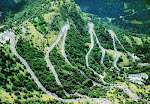
We did the Première Manche - the first round - of A Travers, riding across France from Dieppe to Marseille in the summer of 2009, and it was the original inspiration for this blog. And since we enjoyed ourselves so much, we're putting the band back together again for another go in 2013. Like all the top-drawer sporting events, that's a four-year interlude.

This time it's not so much across the entirety of L'Hexagone, but more into it, as the penultimate stage finishes on top of possibly the best-known haut-lieu of the Tour de France, L'Alpe d'Huez. Stage 2's Belgian finish also matches the Alpe for cycling heritage, ending deep in Flanders in Geraardsbergen, famous for that Chapel sitting atop the iconic cobbled Muur.

The only dilemma we face with such a choice of route is the selection of a suitable set of wheels stout enough for the 20% Flandrian pavé, yet sufficiently light for the shallower, smoother, yet unrelenting slopes of the Alps. Interesting. Can I fit two pairs in the van?


THE STAGES

Stage 1: Calais - Cassel: 63km - one 5th Category Climb
Stage 2: Cassel - Geraardsbergen: 133km - five 5th Category Climbs
Stage 3: Geraardsbergen - Charleville-Mézières: 159km - one 5th, one 4th Category Climb
Stage 4: Charleville-Mézières - Chaumont: 189km - three 5th Category Climbs
Stage 5: Chaumont - Salins-Les-Bains: 204km - four 5th, one 4th, one 3rd Category Climb
Stage 6: Salins-Les-Bains - Annecy: 166km - six 5th, two 4th, two 3rd, one 1st Category Climbs
Stage 7: Annecy - L'Alpe d'Huez: 182km - one 2nd, two 1st, two Hors Category Climbs
Stage 8: L'Alpe d'Huez - Grenoble: 93km - one 5th, one 2nd, one 1st Category Climb


Add to Technorati Favorites


Thursday, 21 June 2012

One To Treasure: Autographed Livre d'Or 1987

Even the man's signature shows his fun-loving side:

Right - Get that on eBay, pronto!!
I met Roche in Valloire in July 1996, in a blowing gale and single-digit temperatures as riders were ferried to an alternative start for the shortened stage to Sestrieres. His signature with the doodle of the bike was the same back then, and is a humourous indicator of how much he still loves cycling. You only have to chat with him for a moment to realise that he's not only a true professional who was one of the best in the world at his chosen sport, but that it was always so much more than just a job for him. His continued affection for cycling is obvious, and I'm delighted to report, highly contagious.

Wednesday, 20 June 2012

Stephen Roche - Born To Be A Rider

From Wikipedia:
Blarney is something more than mere flattery. It is flattery sweetened by humour and flavoured by wit. Those who mix with Irish folk have many examples of it in their everyday experience.
And so it was that two leading proponents of the genre - owner & compere Frank Beechinor and cycling hero Stephen Roche - came to provide us with a masterclass in the art, in an evening at Cadence Performance in Crystal Palace, one of a number of venues Roche has visited on a tour to promote his new autobiography, Born To Ride. I'm still buzzing about how much fun this was.

Remind me. Who is the book about?
I know the title of this post isn't exactly that of the book - which incidentally was going to be the darker and more interesting "Angels and Demons" - but it's my take on it. It's entirely intentional: Anquetil was clearly born to ride, as were Kelly and Cavendish. But Roche really was born to be a rider, in the completest sense of the word. As a fan, and undoubtedly for any sponsor, he's exactly the type of successful yet eloquent modern athlete I'd not only enjoy witnessing winning, as so often he did, but I'd also want to listen to and be representing my brand. He's effortlessly engaging, a marketing man's dream, with a commercial value beyond being a fast-moving logo-plastered sandwich board for a multitude of corporate backers. A prolific, stylish winner on the bike, you could always rely on Roche for a brilliant quote once off it. Gift of the gab, yes. Irish Blarney, if you like.

I always cringe when sportsman are asked to, for example, 'talk us through that second goal'. There's very little point, really. Do we simply expect too much from our sporting heroes? I admit it's far too easy to criticise footballers in particular for their banality, in no small part due to the ubiquity of the sport's coverage, and I'm unreservedly grateful that cycling is getting more of a look-in in the UK given the success of the British contingent on Team Sky. However, I'm nevertheless hard-pushed to find Cav's constant thanks for his team-mates particularly edifying. He's undoubtedly accurate and being genuine, minding his 'P's and 'Q's, but in my opinion he's not engaging anyone other than a very narrow audience of previously converted geeky followers. I'd like the real Mark Cavendish to stand up please, warts and all. Fortunately Wiggo has a tendency to be a bit more of a loose canon, prone to inadvertently saying something that - heaven forbid - doesn't fit in with strictly moderated sponsor 'messaging'. It's so much more interesting when he goes off-script. But when we talk about Roche, well, Roche is in a different league.

Some of the evening's anecdotes surrounding his exploits and antics are better known than others. On the 1987 La Plagne stage collapse - Liggett's memorable commentary maître d'œuvre - and so exhausted that he's unable to talk, he describes his communicating with the Tour doctor by blinking as 'not a great conversation'. The audience is in stitches. This alongside the much-publicised gem of a response to a TV interviewer as he lies prostrate in the ambulance, and 'not ready for a woman just yet'. From the Stephen Roche Story DVD, asked for the secret of his first stage-race success in the 1981 Paris Nice, a young Roche, already showing an excellent command of the language, reveals "Chez nous on mange beaucoup de patates" - in our house we eat a lot of potatoes. It's media-savvy, instantly endearing genius. Tonight perhaps only he could have got away with his highly amusing impression of Sean Kelly because he's a fellow Irishman and friend. I failed in an attempt to stifle my laughter, the flimsy urge for political correctness brushed aside by something simple, peurile, and most of all, fun. It was spot on.

It didn't matter that there was much talk about aspects of the book that as fans we were, for the most part, well aware of already. It was all there: his violent persecution by the Italian tifosi as 'a traitor' for taking the race to incumbent Giro winner and 1987 team-mate Roberto Visentini in what photographer Graham Watson describes as the 'best stage race he's ever seen'.

Visentini in his usual spot: on Roche's rear wheel.
On strategy for winning the Tour, he gave us revealing insights into the tactical nous for which he's held in particularly high esteem: the constant on-the-road observation and decision making, the evening planning for the days ahead, potential alliances with other teams, and the analysis of his rivals' state of both body and mind. And who thought bike racing was just about riding fast?

Make mine a Triple.
Similarly the revelation that he might not have won The Triple if it hadn't been for the weather. The 1987 Giro witnessed unseasonally cold conditions in the normally cauldron-like south, the Tour had hot days interspersed with the sort of colder, wetter weather Roche thrived in, and the World professional road race was run off in low temperatures and early-morning rain. I'd helped out with the supporting video presentation for the evening, and the clip that was shown of his rainbow-jersey winning ride - again, not widely broadcast in the UK, if at all, at the time - was met with a virtual standing ovation from the 100-plus guests. His move through a gap barely wide enough for his Benotto-taped Cinelli 64's was the epitome of audicity, the toothy smile breaking across the grubby face of a World Champion who'd earned his title competing in the rain and cold for 7 hours. The hair stood up on the back of my neck, because here we were standing next to the man that did that.

When asked to compare racing from then with now, the pressure on today's pros is something that Roche unsurprisingly has opinions on, not least I expect because it's the place where his son Nicholas plies his trade. For someone wrestling with the predictability of modern racing, I'm particularly interested in his views. Roche bemoans that fact the today's riders are too willing to ride for second place, for UCI World Tour points, to defend their 'interests' rather than seizing an opportunity to win. The result is that the radio-controlled racing has become formulaic and predictable, with Roche repeating his Carrera DS Davide Boifava's mantra 'to win you have to be prepared to lose'. His view that today's riders - still living in Armstrong 'era of the robots' - don't seem to enjoy the sport as much as they did in the past also chimes well with Laurent Fignon's Nous Etions Jeunes / We Were Young And Carefree - another recommended read. Whilst multilingual Roche may well have found the PR side of his work easy - and enjoyable - compared with most, he obviously still had to deal with the uncertainty and contractual wrangles brought about by his recurring struggles with injury. The overall tone is that modern cycling appears to have lost its sense of fun, that it's no longer anything like a game. Gone is respect, tradition and character, replaced with the modern-day practice of building riders up, pushing them as prodcuts, expecting so much on a sporting and commercial level, and then abandoning them when they fail - the fear of which means no one is prepared to take any risks. You can see this change slowly yet inexorably creeping in, and for me it's not a positive development.

Peter Cossins has done a fine job of bringing everything together in a highly enjoyable read. Despite being a massive fan of cycling from this era in particular - for reasons outlined in the paragraph above - it doesn't matter one iota that I was already aware of most of what has been written in the book. As The Washing Machine Post so eloquently points out, you knew what was coming, because you'd been interested all along:
Biographies and autobiographies suffer from the same intrinsic problem; most of the intended readership already know that the butler did it. the destination is often already well kent; the motivation for purchase is more about the journey.
Un champion du monde peut en cacher un autre ...
Now imagine being treated to a book - and career - review with the man himself. Roche augments the whole experience with has insights, amusing anecdotes, banter and witticisms. All in all, a wonderfully enjoyable evening, and enough to make me want to jump aboard that old steel bike, ditch the helmet and feel the wind in my greying hair, to go and ride with all the enthusiasm of the 20-year-old carefree young man I was back when Roche was astounding us all with his 1987 'annus mirabilis'

I'm well known as a died-in-the-wool Hinaultista, but I'm quickly gravitating towards Roche after this evening. My wife Kelda and I hung around to the end of the event to get him to autograph a multitude of my 1987 copies of Miroir, Vélo and Bicisport, and he seemed to genuinely enjoy looking back at the images. He surely wouldn't be human if there was no lingering nostalgia for the pro rider he once was, and I'd guess that it's undoubtedly the case. Plans are underway, through Frank's various contacts, to get Le Blaireau up to Cadence for a similar evening, but he's really gonna have to go some to match the Irishman's charm, to be sure.


Friday, 1 June 2012

Will We Be Dancing On The Alpe in 2013?

Here's me showing the boys how to let their sweat-sodden, salt-encrusted hair down in Carry-Le-Rouet, after we'd all completed the end of the final stage of A Travers in July 2009. If I hadn't taken up cycling, I'd probably have been a dancer. I'm not referred to as 'Mincer' for no reason, riding around (and walking, come to that) looking like the unholy bastard (and admittedly miraculous) lovechild of and Alan Carr and Graham Norton.


There's clearly the heady mix of relief and euphoria, the plentiful cheap alcohol carried by hyper-oxygenated red blood cells to flood my brain, causing me to show some uncharacteristic joie de vivre. Because underneath I'm absolutely seething: as documented elsewhere in the blog, I was pipped to the finish down on the Med coast by Jamesy, yet a-bloody-gain.The man has no class. Can't he let me win? Just once? Can we just not be racing each other all the time?

So, come the Alpe in 2013 (he's never ridden it, despite my repeated attempts to get him to do it over the years, so I have the advantage of familiarity) I promise that for once there'll be no more nice guy, none of my usual 'won't it be nostalgic and sentimental to ride up together' and finish like a couple of 1986 hand-in-hand Greg & Bernards. Instead I'm gonna behave just like him, the competitive sod, and even though it's not a race and it doesn't really matter, I'm gonna get to the top before him. Whatever it takes. I might even get an accomplice to stand along the route taking photos near the top.

video

Whooh! Hark at me! Call me Macho, rather than Mincing, Mike Curtis, clearly trying the shake off the effeminate tag (it's probably the one I left attached to the collar of the delightful chiffon blouse I just bought myself).

Monday, 7 May 2012

Electric Gears - Energy Saving? Illegal?

I'm no luddite, but ... isn't electric gear changing via an external power source an artificial aid, and as such shouldn't be permitted? There's a battery strapped to the downtube, in case you were unsure. So where do you draw the line? Electrically aided gear changing is OK, but it's obvious that Fabian Cancellara's motorised bike isn't.


As Fabian himself puts it about this 'doped' bike "It's so stupid I'm speechless," he said. "I've never had batteries on my bike." Never used Di2 then, Fabian? I'd dispute that.

I'm all for technology bringing benefits to bike riders, but surely the whole point in racing is that the person who wins - whether a TT or road race - is the one with the most energy left for racing their bike in the final, as Sean Kelly might say. And that should mean everything on the bike - including gear shifts - being powered by the rider alone.

Sunday, 6 May 2012

Something Missing?

It's probably a fair statement to say that the majority of bikes at the top-end of the market are assembled piecemeal from individually-purchased components, carefully selected by the discerning bikie after long hours of deliberation and research; it's a process that can easily descend into near obsession and the topic of often-heated conversations on many a club run. Cutting-edge composite technology and metal engineering and their influence on our component choices are an integral part of the racing cycling experience, and an aspect that makes the sport even more engaging, certainly for a poseur and geek like me. Alongside training miles, race results and clothing choices, everything about the dream bike's build is a pored-over choice, discussed and debated, and not only for what are supposedly the extremely personal 'contact' points like saddle, bars and ... pedals. Yeah, pedals. Kinda vital on a bike, wouldn't you say?

Given the role they play, what I'm finding difficult to understand is why bike manufacturers are increasingly viewing this component as somehow optional in their advertising. Surely their omission renders the bike incomplete, unrideable, useless, in the same vein as advertising a Ferrari without its Pirelli P Zeroes might be. Look through bike mags and sites and you'll note the trend to include bike weights quoted excluding pedals, as if this unsung component were somehow simply an optional extra. Marvel over expensively lit studio shots of the top-of-the-range machine in question, nothing left to chance in the attempt to engender unbridled desire for their product, and the very means of propulsion are missing. If it were a refreshing bottle of lager, it would've had the complete food-stylist treatment and be sprayed with droplets of condensation, to reach out and whisper 'chilled' and 'thirst quenching'. On bikes the ten-past-ten wristwatch-marketing equivalent has always been displaying the bike in the big ring and smallest sprocket, since 53x12 shouts speed (but only when you're using our bike, obviously). But including pedals, surely.

I've already mentioned the wonderful advertising that Ten Speed Drive Imports used to place in Winning Magazine in the 1980s in this blog - it was teenage desire-affirming hard-core bike porn, not seen anything like it since, more's the pity - and the pedals were always on there. Why wouldn't they be?

Image by steel-is-real
Perhaps back in the day it was a given that if you'd selected a Campag gruppo for your bike, then the pedals would also be from Vicenza - and no doubt matched with their alloy toe-clips and Alfredo Binda Extra toestraps. The same would be true of a Shimano or Stronglight/Spidel equipped bike: all the advertisements would include a pedal, out of - dare I venture - completeness. So, was it simply because in the past there was less choice, and so less scope for upsetting a potential punter's sensibilities with the inclusion of what might not be their preferred pedal? Best not try and influence their thinking, heh?
Today, the bars, the saddle, the groupset, wheels and tyres are all still there - unsurprisingly to me - but frame manufacturers appear to baulk at going as far as including pedals. The only reason I can think for their exclusion is that the multitude of providers, styles and engagement mechanisms preclude them from being displayed, as if the frame manufacturer is avoiding the endorsement of a particular brand or mechanism through fear of causing some kind of offence - we're all so easily offended these days after all - leaving this gaping hole in the complete picture to be filled by the consumer's personal whim. Show them a pedal option they don't like, and they might pass on the bike as a whole. Then again, surely any component selection is only about personal taste, and we can mix and match as much as we like (although it's not something I'd do - I'm unashamedly Italian when it comes to what I choose for my bikes)?

So what is it with pedals? Check out these top-flight 'hero' bikes on these manufacturers' sites, and you'll note that there's not a pedal to be seen:

I don't get it. I've already touched on contact points (yep, pun intended), but surely tyre choice is just as personal, with a potentially broader gamut available depending on intended usage. The modern trend for factory-built wheelsets would also undermine this reasoning - high-profile or low, ceramic bearings or not, tubulars or clinchers. Or even the latest road-tubeless innovations. So, does anyone out there have any ideas? What is it about poor old pedals that makes them persona non-grata in bike advertsing?